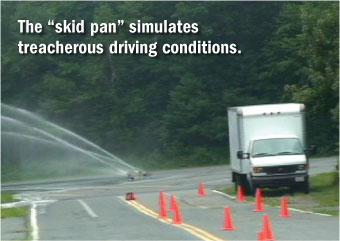
 While it may lack the twists and turns of the test tracks used by Porsche and Ferrari, Liberty Mutual's "skid pan" at its Research Institute for Safety still sees a lot of stomach-churning driving—and the three-acre automotive test area employs a lot of serious science to help make roads safer for everyone.
For the insurer's numerous commercial-fleet customers, the test track is the home of the in-vehicle training segment of the Liberty Mutual Decision Driving Program. Thousands of truck drivers—and at least one insurance reporter—have learned safer driving habits on this specially built track.
DON'T KNOW JACK(KNIFE)
While the skid pan lends itself to many uses, one of the most important is demonstrating to clients—in an unforgettable fashion—just how important anti-lock brakes can be in preventing commercial-vehicle accidents—and the six-figure (or higher) claims that accompany them.
"The most common type of crash event the commercial vehicles we insure used to suffer was jackknifes," says Dave Money, technical director of transportation for Liberty Mutual. "Drivers would hit the brakes hard in an emergency, and the first thing the vehicle wants to do is spin—and spin quick."
The average cost to Liberty Mutual for a jackknife claim 10 years ago was $170,000. "Think about it," says Money. "The tractor is $100,000; the trailer is worth $20,000. It doesn't take much—just a little extra property damage—to get to that figure."
These days the number of jackknifes is drastically lower than in years past—due mostly to advances in anti-lock brake systems (ABS), which prevent the wheels from seizing up and causing a loss of control. ABS have prevented 80-85 percent of jackknifes, according to Money. "The result has just been phenomenal in the commercial-vehicle industry and with our insureds," he adds.
Although anti-lock brakes are now standard on most commercial vehicles, that doesn't mean all or even most drivers know how to maximize their effectiveness to stop fast and stay in control. And this is where the test track comes into play: letting drivers experience an actual braking emergency in a controlled environment, with expert instructors in the cab with them.
"Our role is to educate our customers," says Money. "We have provided some significant knowledge on ABS' operation, function and capabilities to customers who have participated in training with us." It is through this education, he explains, that customers can truly appreciate the value of ABS usage in their own fleets.
Clients climb (carefully, as mishaps that occur while entering/exiting trucks account for a high frequency of commercial claims) into the truck's cab where the instructor, riding shotgun, has the ability to turn the ABS on and off.
To make the test even more challenging, the track is slicked down with water at a quarter-inch depth and coated with a coal-tar emulsion from which grit has been removed.
"We want it slippery," says Money, with the slightest hint of glee. "The track has a coefficient of friction of .2, the same as ice. We don't let people walk on it."
NU BEHIND THE WHEEL
Because Money is both a brave man and one with great confidence in the safety precautions Liberty Mutual has built into its test trucks, he agreed to let NU get behind the wheel on the day of our visit—despite the fact that we hardly ever drive passenger cars—and had never even been in a truck cab.
In the first test, at a speed of just 25 mph and with no trailer attached to the cab, we slammed on the brakes without ABS—and got the scary thrill of a screeching 360-degree wipeout. Thanks to the tractor being carefully rigged not to roll, we emerged mostly unscathed, with only a bruised elbow from a whack on the door handle.
For the next test, we switched trucks—to one with an (empty) trailer and specially outfitted with anti-jackknife cables (which are impractical for real-life street use because they limit turning). We reached our 25 mph cruising speed and smashed the brakes, with ABS off. While we didn't spin, it took us nearly 100 yards to stop—and we had very little control over where we wound up.
In the final test, in the same truck, the ABS was on. We pushed the speed up to 30 mph, pressed the brakes as if our life depended on it—and this time we were able to smoothly steer the truck into the left lane, as instructed by Money, and came to a stop a great distance short of where we had finally come to a halt before.
In the accompanying video (see page 15), digital subscribers can see for themselves the results of the test. Suffice it to say, we were sold—completely, totally, permanently—on the virtues of ABS.
"Maybe the coolest thing about anti-lock brakes is they allow a driver to do what comes naturally in an emergency: panic," says Money.
© Arc, All Rights Reserved. Request academic re-use from www.copyright.com. All other uses, submit a request to TMSalesOperations@arc-network.com. For more information visit Asset & Logo Licensing.