In an effort to maintain or boost their attendance, museums are trying new strategies that range from pushing the envelope with exhibition content to generating revenue by utilizing their real estate in creative ways. These gambits are keeping insurance carriers on their toes, placing even greater importance on loss-control programs and risk management.
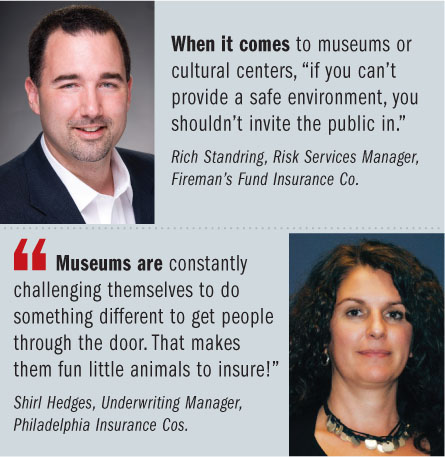 "[Museum-goers] are getting tired of the same-old, same-old," observes Shirl Hedges, an underwriting manager at Philadelphia Insurance Cos., who counts cultural organizations among her specialties. "So museums are constantly challenging themselves to do something different to get people through the door. That makes them fun little animals to insure!"
Ideally, museum administrators can predict audience behavior ahead of time and plan accordingly. For instance, curators at the National Gallery in London knew they'd created a blockbuster when advance tickets for "Leonardo da Vinci: Painter at the Court of Milan" sold out six months before the exhibition opened in November.
But officials at New York City's Metropolitan Museum of Art instead saw a slow build in interest for their summertime show "Alexander McQueen: Savage Beauty"—which, with 661,509 visitors, ranked eighth among the institution's Top 10 most-attended special exhibitions. In the show's final days, people waited hours in lines that snaked throughout the building, outside and around it.
In a stagnant economy, such success makes other cultural institutions envious. But growing crowds also fuel a potential rise in liabilities, from slip-and-fall claims to disgruntled patrons who start fights with other visitors and guards, which make pre-planning essential.
The National Gallery was fortunate in having time to plan ahead for managing its blockbuster show. It restricted the number of simultaneous gallery visitors to just 180—fewer than the 230 maximum allowed—and admitted them at timed intervals.
The Met also addressed some potential crowd-control issues ahead of time, says Harold Holzer, senior vice president of external affairs. Anticipating a bottleneck around a particular holographic display, for instance, curators changed its design to accommodate more viewers simultaneously.
Still, although the McQueen show received favorable reviews, many visitors complained about the wait, overcrowding, and rude patrons who cut the line or created trouble for security guards.
Museums also continue to explore other ways of generating revenue above and beyond exhibitions. Many are offering musical performances as well as wine-and-cheese nights, sometimes complemented by behind-the-scenes tours through typically private spaces such as basements and attics.
However, "Once you start adding these things, you're opening up a whole slew of new exposures," says Bradley Jones, a risk manager with Fireman's Fund. It's critical for museums—particularly smaller ones that lack in-house risk managers—to approach their carriers ahead of time, he says, to review policy limits and conduct due diligence.
Loss prevention could mean serving only white wine at social events, because it's less likely to stain, or erecting temporary barricades to prevent intoxicated visitors from getting too close to art and artifacts.
The key to managing success is evaluating potential concerns with a risk manager ahead of time. "If you can anticipate that a [negative] situation will occur and you don't take appropriate action, you're negligent," observes Rich Standring, a risk services manager for Fireman's Fund Insurance Co. "If you can't provide a safe environment, you shouldn't invite the public in."
© Arc, All Rights Reserved. Request academic re-use from www.copyright.com. All other uses, submit a request to TMSalesOperations@arc-network.com. For more information visit Asset & Logo Licensing.