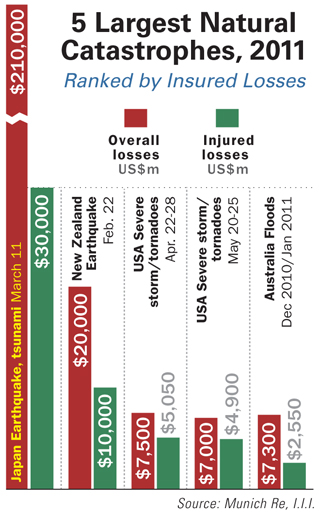
 Global catastrophes in the first half of the year have already made 2011 the costliest year on record with respect to economic losses. According to a recent webinar held by Munich Re, a total of 355 events occurred in the first six months of 2011, causing economic losses of around $265 billion. In the U.S. alone, there were 100 events causing more than $18 billion in insured losses.
 "It has been a momentous year so far—one for the record books," said Robert P. Hartwig, Insurance Information Institute (I.I.I.) president, who spoke at the Munich Re webinar, "2011 Half-Year National Catastrophe Review."
Hartwig noted that three events of the past six months have been added to the list of the 16 costliest insured world disasters. He also said that this year thus far has been unusual in that numerous major disasters fell outside of U.S. soil, explaining a "sense of rewriting the economics of the history of disaster in the U.S. and on the global scale."
While not as brutal as March, April and May, June saw plenty of losses as well. In the first 10 days of June alone, U.S. insurers received more than 45,000 claims from severe weather outbreaks, paying out approximately $250 million to insureds, according to Aon Benfield's "Monthly Catastrophe Recap Report."
Those numbers do not include losses from several wildfires that hit Arizona, New Mexico, Texas and Florida, destroying close to 300 structures and burning hundreds of thousands of acres. Two people died in those fires.
Between June 16 and 23, storm systems hitting the central U.S. caused damage in the Chicago area and Churchill Downs racetrack in Kentucky. Fires in the Southwest at the end of the month resulted in $500 million in economic damage to timber to be used for lumber, plywood and paper products.
Steve Bowen, senior meteorologist at Aon Benfield's Impact Forecasting team, says June's severe weather added to the "$15.5 billion already seen during the January to May 2011 period."
"June was [actually] a reprieve from what we've seen this year thus far," he added. "As we head closer toward the peak of the Atlantic hurricane season, the focus will continue to be on the potential for a land-falling U.S. hurricane."
© Arc, All Rights Reserved. Request academic re-use from www.copyright.com. All other uses, submit a request to TMSalesOperations@arc-network.com. For more information visit Asset & Logo Licensing.