NU Online News Service, July 6, 12:17 p.m. EDT
June insurance rates took another step toward pricing moderation as overall average property and casualty rate decreases dropped from a three-month run of minus-4 percent to minus-3 percent, according to MarketScout.
The Dallas-based online insurance exchange released its latest monthly barometer, with its chief executive officer commenting that indicators point to the beginning of a market turnaround.
“It looks like workers' compensation will be the coverage leading us out of the soft market,” says Richard Kerr, MarketScout's CEO. “Rates for workers' compensation are up 1 percent. Workers' comp is the only coverage with an actual rate increase in June.”
MarketScout says while workers' comp can vary from state to state, there are some larger issues impacting the line. One large insurer left the monoline workers' comp market, and another is not accepting new business in four states: Colorado, Georgia, Oregon and Pennsylvania.
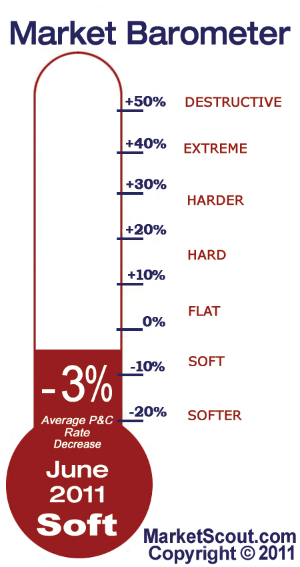 Kerr says some carriers remain aggressive in pursuing some workers' comp business, principally insurers with online platforms seeking accounts of under $100,000 with less hazardous standard industrial classification (SIC).
“Online business is a price-driven, competitive segment of the market,” Kerr says in a statement.
He says this segment of the market is experiencing rate reductions in the range of 3-4 percent.
However, more difficult risks are experiencing rate increases, he says. Prices are flat for accounts that don't fit the online model “and require a regional underwriter's approval,” while difficult accounts that require closer underwriting scrutiny can see increases up to 7 percent.
Of coverage classes, commercial property and general liability show the largest rate decreases at minus-3 percent. Last month, commercial property stood at minus-2 percent, while general liability remained at minus-3 percent.
Six classes of business—BOP (business owner's policy), professional liability, D&O (directors and officers) liability, EPLI (employment practices liability), crime and surety—were all flat.
In an analyst's note, Meyer Shields with Stifel Nicolaus says the “insurers' deteriorating calendar-year results” is “the primary catalyst, which should accelerate as favorable reserve-development tailwinds subside.” He went on to say that as “reserve redundancies fade” they will ultimately necessitate “modest rate increases that should grow into a 2012 hard market.”
© Arc, All Rights Reserved. Request academic re-use from www.copyright.com. All other uses, submit a request to TMSalesOperations@arc-network.com. For more information visit Asset & Logo Licensing.