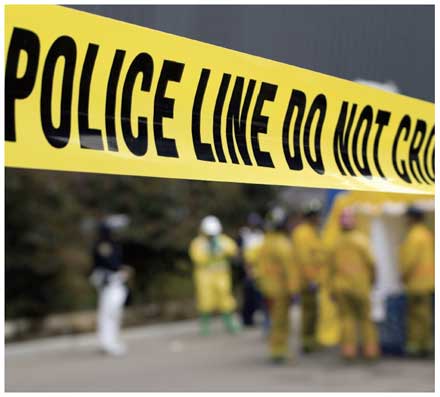
 Suddenly a breaking news message appears during your regularly scheduled TV show. A talking head interrupts the program to advise that there has been a shooting at a local high school and to stay tuned for updates from the scene.
A tragedy such as this seems to be nearly a monthly event somewhere in the world. Since 1990, more than 77 shootings have occurred at U.S. schools and colleges, leading to the deaths of more than 167 students and teachers/staff. This compares with seven deaths in five such shootings in Canada; 14 in all of Europe, with 91 fatalities; and eight in the rest of the world, with 29 fatalities.
This does not include the recent rash of school killings in China between March and May of 2010. During six individual incidents in China, men burst into schools and stabbed children as young as five years old with meat cleavers or other weapons. The murderers ranged from unemployed farmers to a physician. These figures also do not include the many children who have been casualties of war and radical anti-education fundamentalism in Iraq and Afghanistan.
When we combine these shootings with the death toll of school children and teachers in natural disasters—the earthquakes or tsunamis in Haiti, South America, or the Indian Ocean area—along with fires and other calamities, school disasters are an almost weekly occurrence somewhere in the world. Often the problem can be traced to poor construction of schools. For instance, mud and bricks may fall and collapse in even a moderate quake; some schools are located in vulnerable places; or authorities fail to adequately manage the risks.
Have we all suddenly gone nuts? The first school shooting I can recall hearing about was the death of 14 students on August 1, 1966, on the campus of the University of Texas, Austin. I can still envision the photos of the high tower from which the deranged shooter launched his attack. On May 4, 1970, four students died in a volley of gunfire from the National Guard on the campus of Kent State University in Ohio. Their crime was protesting the Vietnam War, which killed thousands of innocent Vietnamese students. Of the 93 U.S. shootings since 1966, 26 happened in Southern states, 11 in California, five in Colorado, with the rest scattered between New England and the Midwest. This does not include the recent shootings in San Antonio, Texas by the Army psychiatrist who elected to start his own jihad.
School Killings Are Not New
Attending public schools was a concept of the latter half of the 19th century. Prior to that, only the wealthy could afford to send their children to an "academy" or to some other private school. Public schools consisted of little more than a brick or a wooden building with one or two classrooms and a schoolmaster who taught all of the grades together. Brick two-room schools remain scattered across the nation, many in the Midwest that have been converted into garages for farm equipment. Schools often met only in the winter months, when families did not need the boys for planting or harvesting, or girls to help rearing younger siblings.
The concept of something beyond the local school where children would be picked up by a bus or ride a trolley to a central location and be placed in an age-appropriate grade did not become commonplace until the early 20th century. Even then, however, there were crazies who set out to murder children and their teachers, often after killing their own families and, later, taking their own lives.
Consider, for example, the more than 300 pounds of TNT used by Andrew Kehoe of Bath, Mich., to blow up the local school because of his anger about a tax increase levied by the township to pay for the school. Thought of by the town's locals as an "infamous miser," Kehoe had even attempted to do the electrical work in the school to save money on electricians. Instead, he chose to place three bombs in the building. One went off, killing 44 people, 30 of them students. Another 500 pounds of TNT did not explode, but when the school superintendent arrived to examine the scene and approached Kehoe, he fired a rifle into dynamite in his truck, creating an explosion that killed not only Kehoe but also the superintendent and seven others. The date was May 18, 1927, the same day that Charles Lindbergh completed the first trans-Atlantic flight.
Other School Disasters
Perhaps surprisingly, shootings and violence were not the greatest killers in our schools at one time. School fires were more common but are now considered by Federal Emergency Management Administration (FEMA) to be "rare," with average damage of less than $15,000 annually in school structure fires and only 13.1 injuries per 1,000 fires—with no fatalities over a three-year period of 2003 to 2005. Even so, school fires that lead the nation to the widespread use of asbestos in school construction, multiple fire escapes, sprinkler systems, and mandatory fire drills.
On Wednesday, March 4, 1908, 175 people burned to death in the Lake View School in Collingwood, Ohio, a suburb of Cleveland. The four-story school had masonry walls, but otherwise was built of wood. An overheated steam pipe allegedly started a fire in the basement, and the fire roared up the main stairway to the third floor. There were no fire doors, and floors were polished with oil, adding to the fire. The building had no exterior fire escapes. Some children jumped from third- and second-floor windows, but those inside were incinerated beyond recognition.
A similar fire occurred at the Grover Cleveland School in Camden, S.C. on May 17, 1923, killing 77 people. The fire occurred in the evening, when, on graduation night, the children were presenting a play. The wooden structure, which was built during President Cleveland's administration, had no fire escapes.
On the afternoon of December 1, 1958, the closing bell was less than 20 minutes from sounding when fire started in rubbish in the basement beneath the central staircase of Our Lady of the Angels School in Chicago, Ill. Students, teachers, and nuns were trapped by fire venting up the staircase. While teachers and nuns rescued hundreds of the more than 1,500 students in the school, 87 children and three nuns perished, according to The New York Times, December 2, 1958. "Firemen who fought their way into a classroom found 24 children sitting dead at their desks," the Times reported. "Books and homework assignments for [the next day] were stacked neatly before the children. Fire Commissioner Robert Quinn said that the boiler room of the building appeared to be intact. An earlier report said that an explosion had occurred there."
"We had a four-mile run to the fire and racing west on our Autocar squad wagon we could see a column of black smoke rising in the gray sky," writes Hal Bruno, retired political director for ABC News and a contributing editor to Firehouse Magazine. Bruno was a reporter for The Chicago American daily newspaper at the time of the fire, and he was spending the day riding as a firefighter with the Chicago Fire Department's Rescue Squad 2. His article appeared in the December, 2008, issue of Firehouse. "Our adrenaline kicked in another notch, and we knew that whatever lay ahead, Squad 2 would follow Captain Leroy Dean anywhere he led us and that we could handle anything we encountered," he wrote. At that point, the radio reported that people were trapped.
"We pulled up near the southeast corner of Our Lady of the Angels School, a two-story, U-shaped building with a brick exterior and wood-lathe and plaster interior, built in 1910," Bruno continued. "The second floor of the north wing was fully involved in heavy black smoke, with flames shooting through the partially collapsed roof. We were ordered to 'open up' the south-wing roof, and climbed up a truck company's wooden aerial ladder. But to reach the truck we had to run through a crowd of parents in the street who were darting back and forth like a flock of birds, looking for their kids."
Bruno concluded the article by saying that the disaster should never have happened. Despite the public attention, it nevertheless "took many years to finally get sprinklers in the schools of Chicago and in schools across the country."
Risk-Managing School Disasters
It is generally up to state and local school boards to prepare for and prevent disasters, such as shootings, fires, or a tornado that suddenly rips a school apart with the children and teachers inside. Insurance claim adjusters inevitably become involved, for whenever there is damage or injury — or worse yet, multiple fatalities — parents will seek to blame those responsible, even if it was a school board that constructed the building decades earlier. Every school shooting will lead to litigation against the shooter, if that person can be found and is still alive. Or, in the case of teenaged shooters, litigation can result against the shooter's parents, leading to homeowners' insurance disputes that have been discussed previously in this column.
Fewer Teaching Staff, More Problems
This month, millions of children will be returning to schools across America. In many of those schools, there will be fewer teachers and larger class sizes than last year because of budget cuts. Where local and state governments spend their money can determine how safe a school system will be. Overcrowding and insufficient teaching staffs cause frustrations that can lead to violence. With so many known killings recently in U.S. schools, invariably there will be more, and the ten major events in the 2009/2010 school year will be close to what can be expected for the 2010/2011 school year.
Why are our schools so violent? The answer to that is the same as to why the nation itself is so violent. We may not yet have suicide bombers blasting themselves to smithereens, as seen in the Middle East. However, we do have a "gun culture" that prides itself on thinking that the Constitution guarantees the right to shoot one another. Undoubtedly, we will see many more tragedies before we see improved school safety.
For claim adjusters dragged into parent-versus-shooter disputes, look first to the coverage. Similar issues have been decided in many (if not most) states, and the court decisions in those earlier cases will serve as a guide to whether the courts will uphold the "intentional act" exclusions in liability policies, or whether the courts may find that exclusions apply only to the shooters and not to the parents or other family members named in the litigation.
When parents are faced with a dead or permanently disabled child as a result of some berserk, deranged student with an automatic assault rifle purchased at a gun show where vendors may or may not have followed federal rules for gun sales, parents' attorneys will seek every potential target. They may go after gun manufacturers, show operators, individual dealers, or perhaps even the local school board that failed to provide adequate security at the school's doors.
Such fears turn our schools into lockdown prisons for children and teenagers. "Zero tolerance" regulations can lead to arrests where no real crime has been committed, such as a child bringing a fishing knife to school for a second grade "show and tell," or, as in one case, a kindergarten boy arrested for sexual harassment for kissing a kindergarten girl. Such ludicrous cases will also create litigation and insurance claims. Be prepared; the best tool an adjuster can possess is imagination.

© Arc, All Rights Reserved. Request academic re-use from www.copyright.com. All other uses, submit a request to TMSalesOperations@arc-network.com. For more information visit Asset & Logo Licensing.