Will nanotechnology be the next asbestos? Will it cause a similar flood of litigation and liabilities that have collectively cost companies that ever manufactured or used the substance hundreds of billions of dollars and driven many of them into bankruptcy?
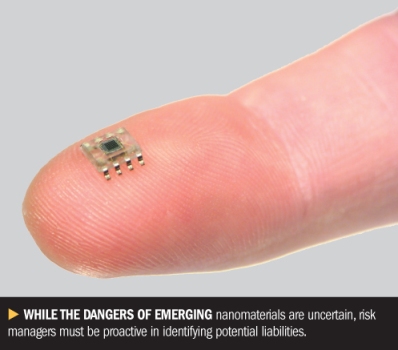 While it's still too early to tell, good risk management suggests that many types of businesses–some seemingly far removed from nanotechnology–are planning ahead and hoping answers to these questions will be negative.
You don't have to be a scientist to understand the significance of some very important facts about nanotechnology and why many companies–not only those that actually manufacture nanomaterials–need to be concerned about them.
The phrase "nanotechnology" is a technological concept–not a particular product. It refers to a wide range of substances manufactured at the atomic and molecular scale. The size of these substances can range from one- to one-hundred nanometers. (For comparison, a sheet of paper is approximately 100,000 nanometers thick!)
An example of a product made with nanomaterials is a tennis racket made with nanotubes. In lay terms, these are miniscule but very strong carbon fibers.
Because of their atomic or molecular size, nanomaterials have unique properties that often are not yet understood.
Nanoparticles–like the nanotubes in tennis rackets, for example–may become airborne during the manufacturing process, and in some uses, when incorporated within other products. This release could lead to serious health or environmental problems.
A commonly cited example of such a problem is the recent discovery that silver nanoparticles blended into socks to reduce foot odor could be released in the laundry cycle. The unintended consequence is that they may destroy the "good" bacteria necessary for breaking down organic matter in waste-water treatment facilities.
On the human health side, some recent studies suggest that inhaling carbon nanotubes may be as harmful as breathing asbestos, or perhaps worse.
Concern exists that the disposal, destruction and recycling of some but not all products made with nanoparticles may exacerbate health risks in ways that are only now beginning to be evaluated, over and above the risks to workers and the environment in the manufacturing process.
The small size of nanoparticles suggests that once released, they may spread over greater geographical areas, may more readily penetrate the body and its cellular structure, and may possess greater toxicity than larger particles of the same substance.
Products developed with nanotechnology are likely to grow by leaps and bounds over the next decade. But surprising is the number of both commercial and consumer products incorporating nanomaterials that already exist and are being sold, as a simple "nanotechnology" Internet search will demonstrate.
Existing consumer products incorporating nanomaterials include sun-screens, cosmetics and skin creams, disinfectants, washing machines, medical devices, packaging, food products, toothpaste and computer components.
The U.S. Environmental Protection Agency estimates that future products or methods that will use or incorporate nanomaterials will include metals, ceramics, composites, fuel cells, drug delivery systems and methods for identifying and treating certain human cells carrying or transmitting particular diseases, as well as processes for converting salt water to drinking water.
 In fact, one study suggests that three-to-four new products based on nanotechnology are introduced into the marketplace each week.
The regulatory scheme concerning the manufacture and use of nanomaterials is virtually just now coming into existence and crosses the jurisdiction of many agencies. In many instances there are no regulations at all, and they vary country by country. It is estimated that such products perhaps are manufactured in as many as 25 countries.
Government regulation may not be relied upon with any degree of certainty by any business to ensure the safety of such materials or their usage, notwithstanding the rising call for regulation and the assertion that some of these products are hazardous to humans and to the environment.
ASESSING NANO RISKS
So what does all this mean to risk management and the question of obtaining insurance for the risk?
Unlike asbestos–a single, defined substance whose medical impact is now widely understood–assessing the risk of nanotechnology is not nearly as simple and may impact a broad spectrum of industries.
A risk manager of a medium-to-large company, for example, may not even be aware of all the substances incorporated into the products it sells or handles, or are used in the services it provides. And with the anticipated explosion in products containing nanoparticles, generating and maintaining a list of products used, handled or included within its products may itself present a Herculean task.
Even if such a compendium exists and is regularly updated, the question remains about evaluation of the risk.
Every nanoparticle may present a different risk based upon its particular "nano-size" and the differing physical properties that it may have for causing human or environmental injury that may be wholly unrelated to another such particle.
Add to that conundrum the nascent stage of the hazard research for any given particle and its potentially varying usage.
COVERAGE ISSUES
The implications for insurance are equally as compelling and uncertain.
Asbestos bodily injury claims primarily triggered workers' compensation and general liability policies.
As is well known with regard to asbestos, historical policies from the 1930s and 1940s have provided coverage under the law that established that occurrence policies are generally triggered during the entire time of the claimant's exposure to the hazardous product, at least through the time of his or her diagnosis.
 That law, however, was predicated in part upon the etiology of asbestos-related diseases. It is not yet known how or when–or in some cases, if–any given nanoparticle causes injury. And, if so, under what conditions or in what products, or whether the implications from one such material or its use may apply to another.
Caution suggests that risk managers need to evaluate this risk and plan for it. It has been widely reported that the expected boom resulting from nanotechnology will likely also yield growth in health and environmental litigation dealing with alleged design defects, failures to warn, sales of inherently dangerous products and even consumer fraud.
As with early litigation arising in the asbestos context some 40 years ago, when the medical and property damage issues were not yet fully developed, the cost of defending nanotechnology-related suits by itself may be huge for a given company.
They may actually or arguably trigger occurrence-based property damage and bodily injury liability, workers' comp, environmental impairment liability, errors and omissions and/or, in certain industries, professional liability policies.
Risk managers need to be proactive in this arena, and may want to formalize a system that requires company vendors to disclose all nanotechnology materials used in products or components they provide–and also obtain such information from subvendors.
From another perspective, potential disclosure on policy applications to a company's insurers must be evaluated, given the vast and quickly changing landscape. This includes products that encompass nanotechnology and the evolving and developing state of knowledge about hazards.
No organization wants to face the allegations made by insurers in coverage litigation against most asbestos companies in the 1980s and oil companies in the 1990s–that their insureds were aware of the harm they were causing, intentionally continued to cause such injury and property damage, and failed to disclose the supposedly known risks to insurers.
Insurers–effectively siding with the litigating plaintiffs against their insureds–often sought to support their assertions by reference to the early studies of asbestos that had similar characteristics in some ways to the early studies of nanoparticles.
What seems like uncertainty and open questions at the time may look much more damaging with hindsight, if the early suggestions of possible risk in certain narrow circumstances turn out in fact to have been accurate and more widely applicable than even first suggested.
Moreover, proposed policies must be reviewed with the risk of nanotechnology-related litigation in mind. This perspective is not often thought of before by most companies not directly in the nanotechnology field. Some, but not all brokers may possess this perspective.
At least one insurer has sought expressly to exclude risks related to nanotechnology, but that has not yet apparently become the norm. But even in the absence of such an exclusion, a risk manager may need a legal analysis of its overall insurance program.
For example, an analysis might be undertaken on the impact of a pollution exclusion in a general liability policy. The policy might, in certain circumstances, be argued to be the functional equivalent of an express exclusion in light of known and suspected, or even unsuspected properties of the products or services the company sells.
It comes down to this: Solid risk management requires a careful review and awareness of all attendant risks facing a company with respect to nanomaterials and the insurance it acquires for such risks.
Awareness is essential, given the rapidly evolving nature of the marketplace, uses of nanomaterials, the currently unknown but suspected potential risks to humans and the environment, and the largely unregulated arena in which all of this change is occurring.
It may be that litigation becomes the earliest form of regulation of this field. Should that occur, however, no company or its management wants to face charges for being caught asleep at the switch.
Stephen Goldberg is a partner in Dickstein Shapiro LLP's Insurance Coverage Practice, focusing on complex commercial litigation, including E&O and D&O liabilities. He can be reached at goldbergs@dicksteinshapiro.com.
© Arc, All Rights Reserved. Request academic re-use from www.copyright.com. All other uses, submit a request to TMSalesOperations@arc-network.com. For more information visit Asset & Logo Licensing.